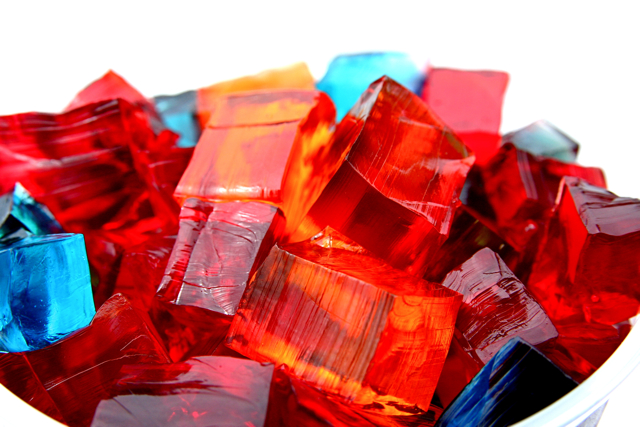
My 4 year old son has been obsessed with states of matter lately (thank you “Sid the Science Kid” and “Zula Patrol.”) He’s constantly pointing out “this is a solid,” and “that is a liquid.” And of course, since he’s four, he’s going to eventually follow up with some kind of “why” question.
Like: “Momma, why do the eggs turn from a liquid to a solid when you cook them?”
Uhhhhh….
…
So it was bound to happen that while we were eating Jello my Little Prince would turn and ask, “Momma, is Jello a liquid or a solid?”
Now THAT, I did remember from science class! The answer is “Neither.” But I couldn’t remember what it was called so I turned to Google because I *heart* Google. (Hey – remember back when we used to look these things up in encyclopedias? (Insert hysterical laughter here.)
I found the answer in several places across the internet but this one had the best explanation that my kids would understand:
Gelatin itself is made of a protein. (Proteins are solids at most temperatures.) When you mix the jello powder into the hot water, the protein actually dissolves in the water. But like many things, it’s harder for the protein to stay dissolved in cold water than in hot water. So as the solution cools down, the protein comes out of solution and turns back into a solid. But it doesn’t just form a solid that settles onto the bottom, like a mixture of water and sand would.
As the protein molecules come out of solution, they stick to each other. When they stick to each other, they form a complicated matrix that runs all through the jello. You can think of it as a giant mixed-up jungle gym of little protein molecules all sticking together. They water molecules get caught up inside this matrix so they can’t just drain out.
So all things said and done, jello is basically a solid suspended in a liquid. The scientific word for this is a ’colloid’. If you heat it up enough, the solid will become dissolved again it will become a liquid all through. But if you cool it down enough, the liquid water will freeze and it will become a solid all through.
So jello is neither a liquid, nor a solid, it is a colloid. You learn something new everyday. Even while eating your dessert. ; )
And just for grins and giggles – you can make your own Jello-style gelatin dessert at home using real fruit juice and gelatin (which we now know is a protein – that adds nutritional value RIGHT?) and without all the artificial flavors and colors. Imagine turning it into a whole science lesson! Make a bowl of jello, chill and set. Put a small serving in the freezer, put a small serving in a sauce pan. The best part? Eating the rest of the jello while you wait for your jello experiments to freeze and melt!
Oh – and for those of you wondering about the eggs? Protein plays an important part in that answer, too. (Read Scene 6 or watch the 2nd video segment.)
Science and food. Food and science. I like this relationship. =)
(P.S. Check out this book about Science Experiments You Can Eat
Share it! Pin it. Print it. Send it.





so…. did you like the recipe alton shared? are you going to be making some???
What– the lemon curd? Perhaps at some point.. I don’t have a good track with that sort of thing though. Tried to make egg nog once.. it’s not supposed to have any lumps in it right? 😉